From Content Factory to Growth Engine: Connecting Creative Output to Revenue
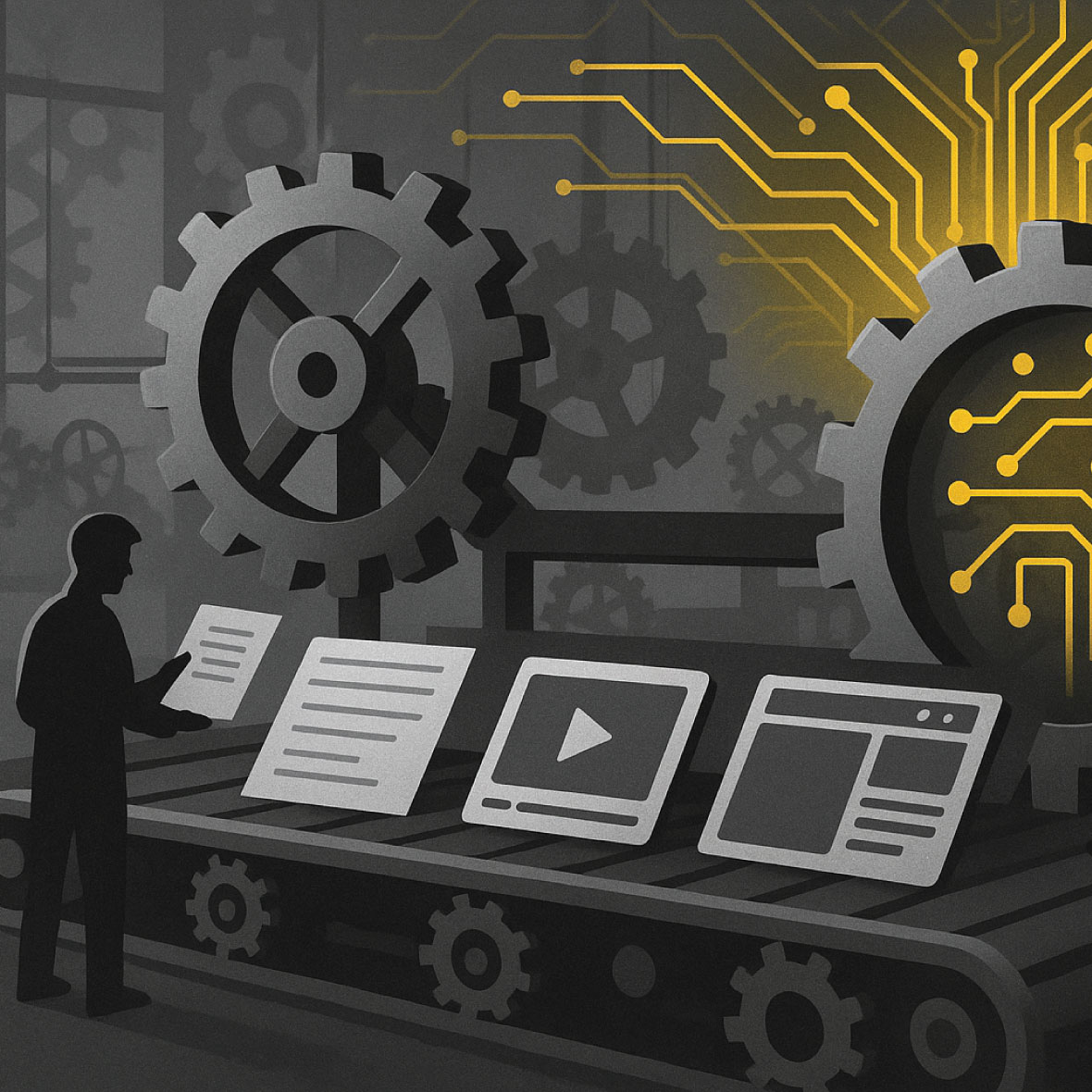
Producing more content is not the same as producing growth. Once the Content Factory is up and running—ideas in, assets out—the next challenge for marketing leaders is ensuring that creative output fuels measurable business outcomes. The Growth Engine Model is the next evolution: wiring content, design, and multimedia into the broader revenue system so that every piece of work drives pipeline momentum and customer value.
The Content Factory Model: Scaling Creative Output Without Sacrificing Craft
Content fuels every stage of B2B growth, yet most organizations are still wrestling with an impossible equation: produce more, faster, and cheaper—without eroding brand quality. Generative AI has solved the “faster” part, but the hard truth remains that quality still wins markets. The Content Factory Model offers a way through that paradox: a hybrid system that blends AI automation, human creativity, and multimedia design into one continuous studio workflow.
Expanding into new markets is rarely a matter of translation alone. Many companies dutifully localize their websites and collateral, yet still miss quota abroad. Success requires more than words on a page; it demands a demand engine designed for local realities—search behavior, sales readiness, cultural cues, and common terminology—so pageviews convert into pipeline and pipeline into durable revenue. CSA Research has shown this for over a decade.
Boards want the architecture and guardrails behind the promise. If Part 1 mapped talent and targets, Part 2 shows how to build the stack that makes agentic workflows safe, observable, and accountable. Below is a pragmatic reference design with the data layer, orchestration, lineage, and evaluation system you can phase in now and operate with confidence by 203012.
Boards want a clear plan for how AI will reshape headcount, spend, and revenue performance. Over the next five years, high-growth companies will redesign go-to-market around human judgment amplified by agentic systems. This article maps the talent mix, KPIs, and budget shifts you can implement now so your revenue engine is faster, leaner, and measurably smarter by 2030.
Read more: AI Revenue Teams 2030, Part 1: Talent, Targets,...
Funded startups once staffed marketing by adding hands to keyboards. Today, large language models draft copy, optimise bids, and even storyboard campaign videos before lunch. That speed is a gift—if leadership also knows how to assemble the right human orchestra to conduct it. This guide maps an AI‑native org design for a B2B SaaS company selling enterprise‑grade software to SMBs, showing how the team, channels, and tech stack evolve from Series A nucleus to a fully fledged Series B growth engine.
Read more: Re‑Engineering Marketing Teams for the AI Era:...
- Beyond the Click: Measuring Demand and Pipeline in an AI-First SERP
- From Snippet to Source: How to Craft Content that AI Search Engines Cite
- ABM After the Cookie Collapse – Part II: Orchestrating Paid Media, Intent, and Direct Mail for Conversion
- Part I – ABM After the Cookie Collapse: Building a First-Party Data Engine